How far a cascade travels
A cleared tile is replaced from above, and the replacement can match again for free. How often that happens is not luck: it depends almost entirely on how deep the hole you made was, and that is something you choose.
Dessert board notes from Edmonton
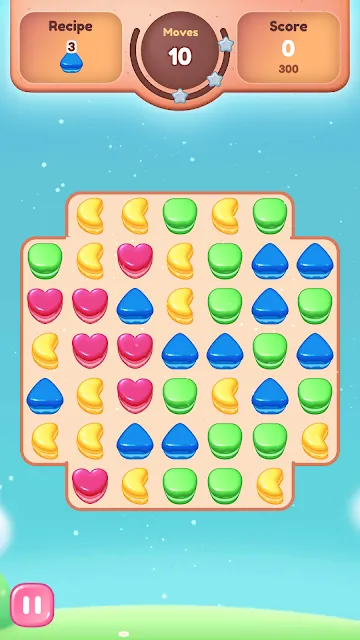
Swap a biscuit for a pastry and three of them vanish; that part takes ten seconds to learn. What takes longer is working out why the same swap clears half the board on one stage and nothing at all on the next. This sweet cookie cascade guide is about the difference, which comes down to where you played rather than what you matched.
Four subjects. Each is here because it changes a decision on the board, and each holds across stages rather than applying to one numbered level that will be reshuffled by the next update.
A cleared tile is replaced from above, and the replacement can match again for free. How often that happens is not luck: it depends almost entirely on how deep the hole you made was, and that is something you choose.
Five in a straight line and five in an L do not produce the same thing. The game never says so, and the difference decides whether you get a piece that clears a line or one that clears a region.
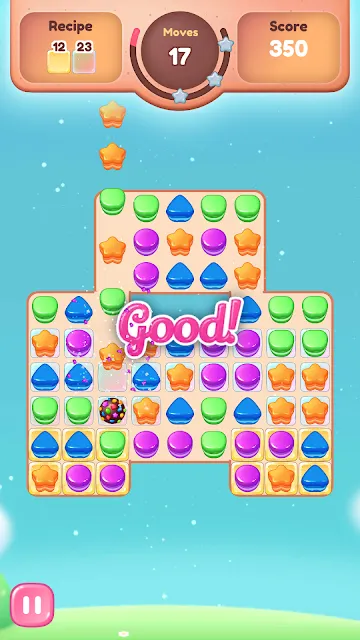
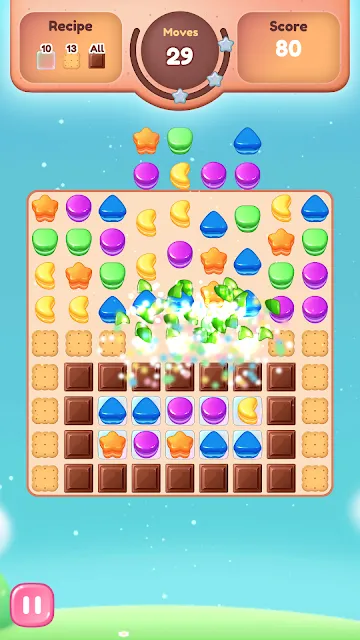
Chocolate spreads, ice chips, chains refuse to move. Three obstacles, three completely different remedies, and taking them in the wrong order is the most common way to run out of moves with the board half done.
Score targets and move limits are set together, which means every stage has an implied rate. Working out what yours is at the halfway point tells you eight turns early whether the stage is still winnable.
The refill is vertical. New tiles enter at the top of a column and fall straight down; nothing slides sideways unless you swap it. Everything else about cascades follows from that one sentence.
Clear three tiles on the bottom row and every tile above them in those columns shifts down, meets a neighbour it has never met, and frequently matches again at no cost. Clear three tiles on the top row and the gap fills from off-screen, where by definition nothing can already match. Identical move, completely different value — and this is the single largest source of wasted turns in the genre.
Depth beats width for the same reason. Eight tiles removed from two columns disturb far more of the board than eight removed along a single row, because the number of tiles forced to move is what produces new matches. When two moves look equally good, take the narrower and lower one.
A practical test: play one stage taking only the lowest available match each turn, then replay it taking the largest available match. The score difference is usually larger than any booster would have made.
Match four and you get a piece that clears a line. Match five in a straight line and you get the strongest piece in the game, the one that removes an entire colour. Match five in an L or a T and you get something different again: a piece that clears the region around itself rather than a line through it.
That third case is the one worth learning, because L and T shapes appear constantly and most players break them up without noticing. On a stage where the objective sits in a cluster — a patch of chocolate, a group of marked cells — a region clear is worth considerably more than a line, and it is available from an arrangement you already have.
Two pieces together escalate again. Two line pieces clear a row and a column through the swap. A line piece with a region piece clears a band three cells deep in both directions. Those are the combinations worth spending a turn to arrange; most others are not, and spending three turns building something clever on a stage that only needed patience is how a comfortable board becomes a lost one.
Three obstacles cover nearly every hard stage. They fail differently, and the last column is why the order matters.
| Blocker | How it behaves | What breaks it | Cost of leaving it |
|---|---|---|---|
| Chocolate | Spreads to an adjacent cell each turn it is not touched | Any match adjacent to it, every turn | Grows faster than you can clear it |
| Ice | Covers the cell, often in two layers | Ordinary matches on top of it | Low; it falls to normal play |
| Chains | Locks the tile so it cannot be swapped | A match that happens to include it | Blocks a whole column from moving |
| Crates | Sit in the cell and absorb one clear | Any match beside them | Each one silently costs an extra move |
A description of how these obstacles behave in this board format. Names and exact behaviour differ between titles; the in-game help screen is authoritative for any particular one.
The order that works is chocolate first because it is the only one that gets worse while you ignore it, then chains because they immobilise a column, then crates, then ice last because ordinary play removes it anyway. Reversing that order is the most reliable way to arrive at the final five moves with the board still covered.
Andrew Wilson, in Edmonton, alone. There is no editorial team, no panel of testers and no scoring system, and it would be dishonest to imply otherwise on a site this size.
What the pages contain is the behaviour of a board format described from playing it — how refill works, what each shape produces, which obstacle punishes delay. Statements of that kind hold across builds and across titles, which is why they are what gets written here instead of stage numbers and walkthroughs that expire.
What is deliberately absent: star ratings, install counts, review scores, tier lists, and any claim about how many games have been tested. None of it can be verified by a reader, and a static page repeating it is stale within weeks.
Anything specific to one app — its price, size, ad model or offline support — belongs on that app’s store listing, and that listing is the only source worth trusting for it. Where such a detail appears here, treat it as a practical indication and check.
The site is free and will stay free. It is also a web page, which means it is behind whatever you are playing; the printed version solves that and nothing else.
Fourteen pages, laid out to be read with a phone in the other hand, and considerably more detailed than the table above — a page has room for four rows, a booklet has room for the rest.
Order it by email Terms of the order
One item sold by a private individual, not a shop. This domain has no checkout, no payment page and collects no card details anywhere: you write, Andrew Wilson replies with transfer details, and the file follows once the transfer arrives. No sales tax is added and no invoice from a registered business is issued. If it does not arrive, or arrives and will not open, say so and the payment goes back in full.
App-specific facts belong on a store page rather than here, so here is one with its labels exactly as the store shows them. Nothing is downloaded from this site.

Open the listing on Google Play
Price, taxes and any fees are shown on Google Play at the next step. Listings change without notice; the date above records only when these labels were last read.
Email is the only channel on this site. No forms, no newsletter, no data collection anywhere — you write, and the reply comes back to the address you used.